
The Value Frontier
The AI discussion is becoming as much about value as capabilities


Hi
Welcome (back) to The Prompt. AI isn’t well understood, but we learn a lot in our work that can help. In this newsletter, we share some of these learnings with you:
How AI will be assessed in its next phase – by value
What the latest polling tells us about US views on AI
Boston Children’s Hospital doctors are using AI to search for answers to rare medical mysteries
If you find them helpful, make sure you’re signed up for the next issue.

[Insight] The value frontier
Since the development of generative AI, there’s been a lot of discussion about the “best” AI models. But the key indicators right now aren’t solely about performance.
The latest model releases show how competitive the AI space is today. Independent evaluators like Artificial Analysis and DeepSWE track models’ cutting-edge capabilities, but also scrutinize cost-per-task, coding-agent performance, execution time, and token use. The frontier of AI development isn’t just about a static exam score – it’s how well a model can do real work and at what cost.
OpenAI’s recently released GPT-5.6 is a good example of where AI developments are heading, with three tiers of capabilities. That approach reflects an important reality: there’s no single “best” model for every job. The best model is the one that delivers the right level of power, latency, reliability, and cost for the task at hand.
On Artificial Analysis’s benchmark, GPT-5.6’s highest tier is the best performing coding agent. But it also does this with greater efficiency – at an estimated 33% lower cost than Claude Fable 5. That is exactly the kind of comparison that matters for developers and businesses: not just, “can it solve the problem?” but, “can it solve the problem well, repeatedly, and economically?”
This is the core of OpenAI’s approach. We want to push the frontier of AI capabilities, but we also want to push the frontier of value. A model that’s more capable but too expensive or too slow will only be useful in narrow settings. A model that’s capable and efficient can be used everywhere: in startups, small businesses, homes, hospitals, classrooms, large enterprises, public services, and developer workflows that run thousands or millions of times.
This efficiency comes from several layers working together.
It comes from infrastructure: better systems for training and serving models, more efficient inference, stronger networking, and the ability to serve high-volume workloads on the right compute. We’re investing in a large-scale compute portfolio – we’re on track to meet our Stargate Project goals ahead of schedule – and are managing this wisely: frontier models use premium infrastructure when capability matters most, while high-volume workloads can run on lower-cost infrastructure where efficiency matters more.
Efficiency also comes from smarter models: tiered models like GPT-5.6 let users choose the right price-performance point instead of forcing every task through the largest model. A coding agent handling a complex project may need advanced capabilities. A product workflow processing thousands of routine tasks may be better served by a simpler model. Many real business systems will use several models together.
Efficiency also comes from better algorithms and inference techniques. Over time, AI progress isn’t just about adding more compute. It’s also about learning how to get more out of the compute we have. We’ve made huge investments – and advances – in training methods, routing, reasoning controls, token efficiency, improved context handling, and systems that reduce unnecessary work.
Taken together, these factors underscore that the latest model race isn’t a simple performance benchmark contest. The leading AI models will combine all the elements people actually care about: the ability to answer questions, solve problems, speed, cost, reliability, and utility in real-world workflows.
The next phase of AI will be defined by this combination: frontier performance and practical economics. AI that is powerful, fast, affordable, and available where people need it. That’s what turns AI from a breakthrough into a tool that benefits everyone. – Adam Cohen, Head of Economic Policy

[Data] Sentiment on AI ticks upward
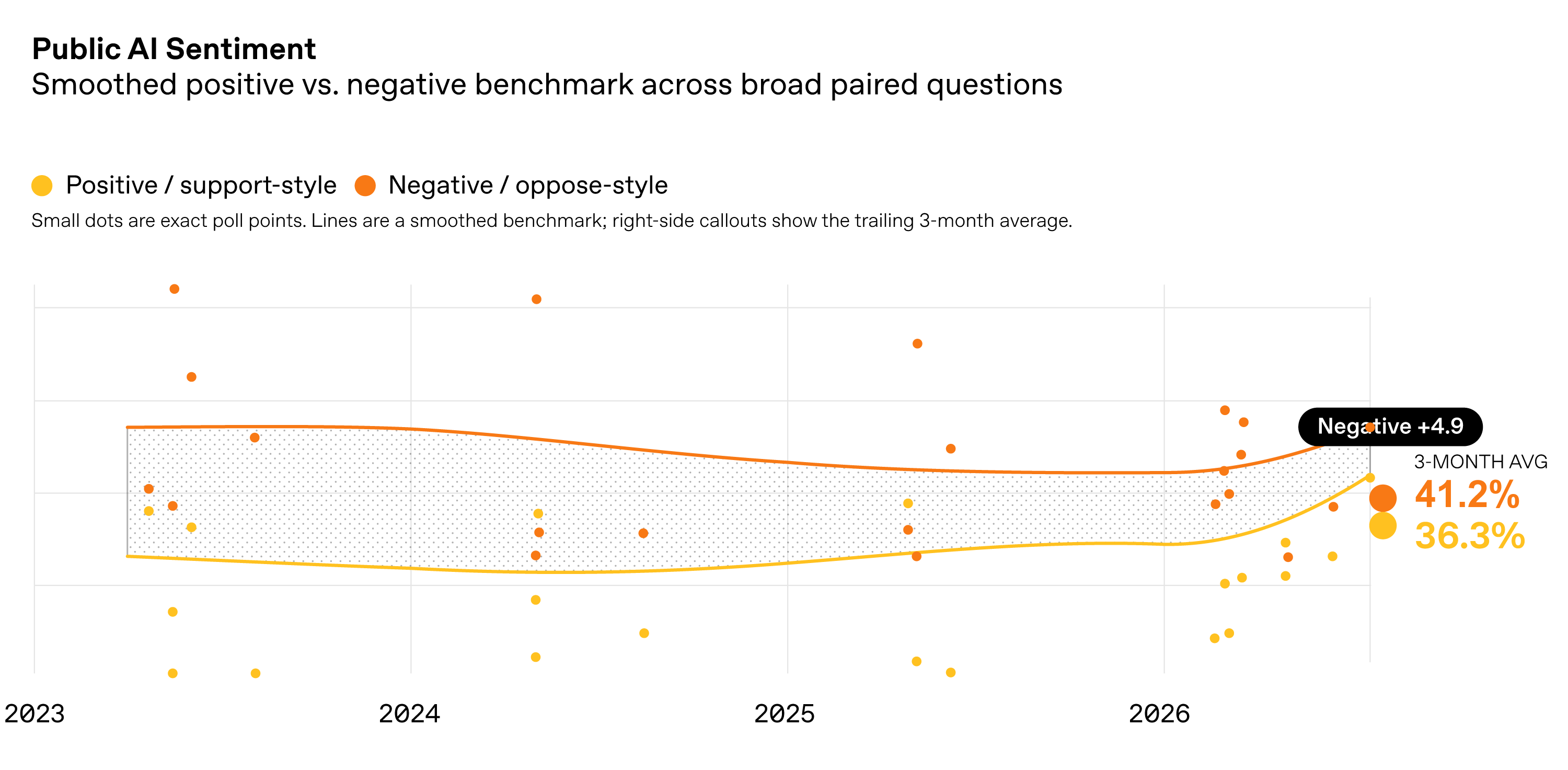
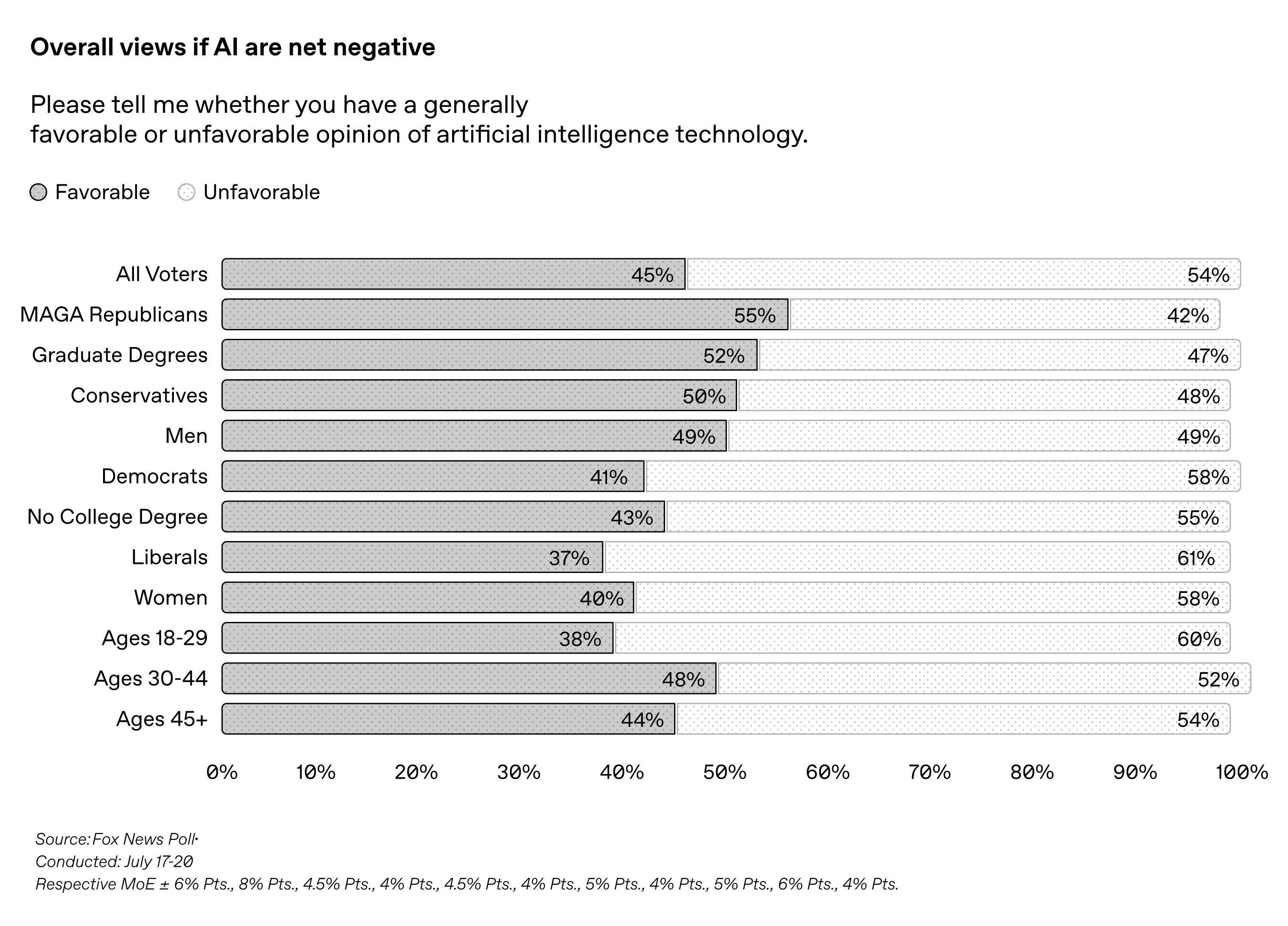
Our latest AI Sentiment Tracker shows a slight uptick in general opinions about AI – going from negative-15 points in June to negative-5 now. The movement is due, in part, to a Fox News poll released late last week showing 45% of registered voters with a favorable view of AI, versus 54% with an unfavorable view.
In the Fox poll, Republicans, conservatives, men, and those with graduate degrees were disproportionately more positive about the technology, while Democrats, liberals, women, and those without college degrees were disproportionately more negative.
The same Fox survey also finds a supermajority of voters – 70% – opposing the building of an AI data center in their area, compared with 30% favoring it.
Speaking of data centers, our own research finds $19 million spent on local broadcast and cable TV ads referencing data centers in this midterm season, with $32 million overall spent on AI-themed ads. AI has become a campaign issue in more than half of the country – 36 states plus DC.
[Forum] Solving medical mysteries with AI
How can AI help physicians solve some of medicine’s hardest cases?
Join the OpenAI Forum this week for a conversation with researchers from Boston Children’s Hospital on how OpenAI o3 Deep Research is helping reanalyze previously unsolved rare pediatric disease cases. The discussion will explore how AI can accelerate scientific discovery, surface promising new leads for expert review, and give more families a path toward answers.

3:15 PM – 4:00 PM EDT on July 30
[Disclosure]
Graphics created by Base Three using ChatGPT.