
Beyond The Bubble Debate
The best measure of AI's future may be how quickly it's becoming part of everyday life


Hi
Welcome (back) to The Prompt. AI isn’t well understood, but we learn a lot in our work that can help. In this newsletter, we share some of these learnings with you:
The strongest signal yet that AI is becoming a utility
Our new 5.6 models are built for more people and more use cases
AI’s growing role in disaster response
If you find them helpful, make sure you’re signed up for the next issue.

[Insight] Beyond the bubble debate
AI developments are driving a familiar skepticism. Is this a bubble? Is massive infrastructure investment crowding out more useful economic activity? Can leading AI labs build sustainable businesses?
These are important questions. Large and rapid technology shifts deserve scrutiny, especially when they require capital, energy, talent, and public trust. But we should be careful to separate the uncertainty around AI as an asset class from the real value it’s already creating.
The strongest signal that AI is more than a novelty isn’t a forecast or a valuation – it’s growing usage. More than a billion people have adopted AI tools over the last few years, including about 1 billion who use ChatGPT, simply because they’re useful. People are using AI to write, learn, code, analyze, translate, plan, and create. They’re using it to start businesses, understand medical diagnoses, navigate complex legal and financial situations, manage their busy lives, and complete tasks that previously would have required far more time, money, or specialized support.
That kind of repeated use is fundamentally different from a curiosity or passing fad. People continue to integrate AI into the way they learn, work, and live because they grasp its value. And they see how AI increasingly can do more and more for them – people who were casual ChatGPT users two years ago are now “power” users, moving from experimentation and simple tasks to take full advantage of our latest models.
That evolution is shaping how we build. Today, we publicly released our new 5.6 Sol, Terra, and Luna models to make more capable AI available to more people and more use cases. It’s another step toward the same goal: expanding what people can do, not simply advancing what AI can do.
Only two years ago, many critics argued that generative AI was little more than a clever word game. They aren’t saying that today. AI capabilities have improved quickly: models have become better at reasoning, coding, multimodal understanding, tool use, and longer-horizon work. The frontier is still imperfect, but it’s clearly advancing. Dismissing this progress as hype risks missing what is already happening around us.
The same is true of infrastructure investment. Some investments will be wrong. Some companies will fail. Not every AI application will justify its capital cost. That’s how major technology cycles work. But that doesn’t mean the buildout is wasteful. If AI becomes a general-purpose technology used across education, healthcare, science, business, and government, then data centers, chips, and deployment, these infrastructure investments are fundamental. They are the critical scaffolding for the next phase of our economy.
None of this means we should be complacent. We need to prepare for changes in work and jobs. We need to reduce environmental impacts, strengthen cybersecurity, and make sure the benefits of AI are broadly shared.
The right posture isn’t blind optimism. But neither is it reflexive dismissal. Much of the current public debate whipsaws between “AI is a bubble” and “AI is changing everything faster than society can manage.” The more productive path is steadier. We should separate durable value from extreme skepticism and hyperbole, and build the institutions, safeguards, and new businesses that help us see the real opportunity that lies before us. – Adam Cohen, Head of Economic Policy

[Event] AI for disaster response
Disaster response often comes down to speed: how fast can help reach people in need? Fast action depends on consolidated, verified information that decision-makers can trust. The challenge isn’t a lack of data; it’s turning thousands of fragmented updates into something useful before time runs out.
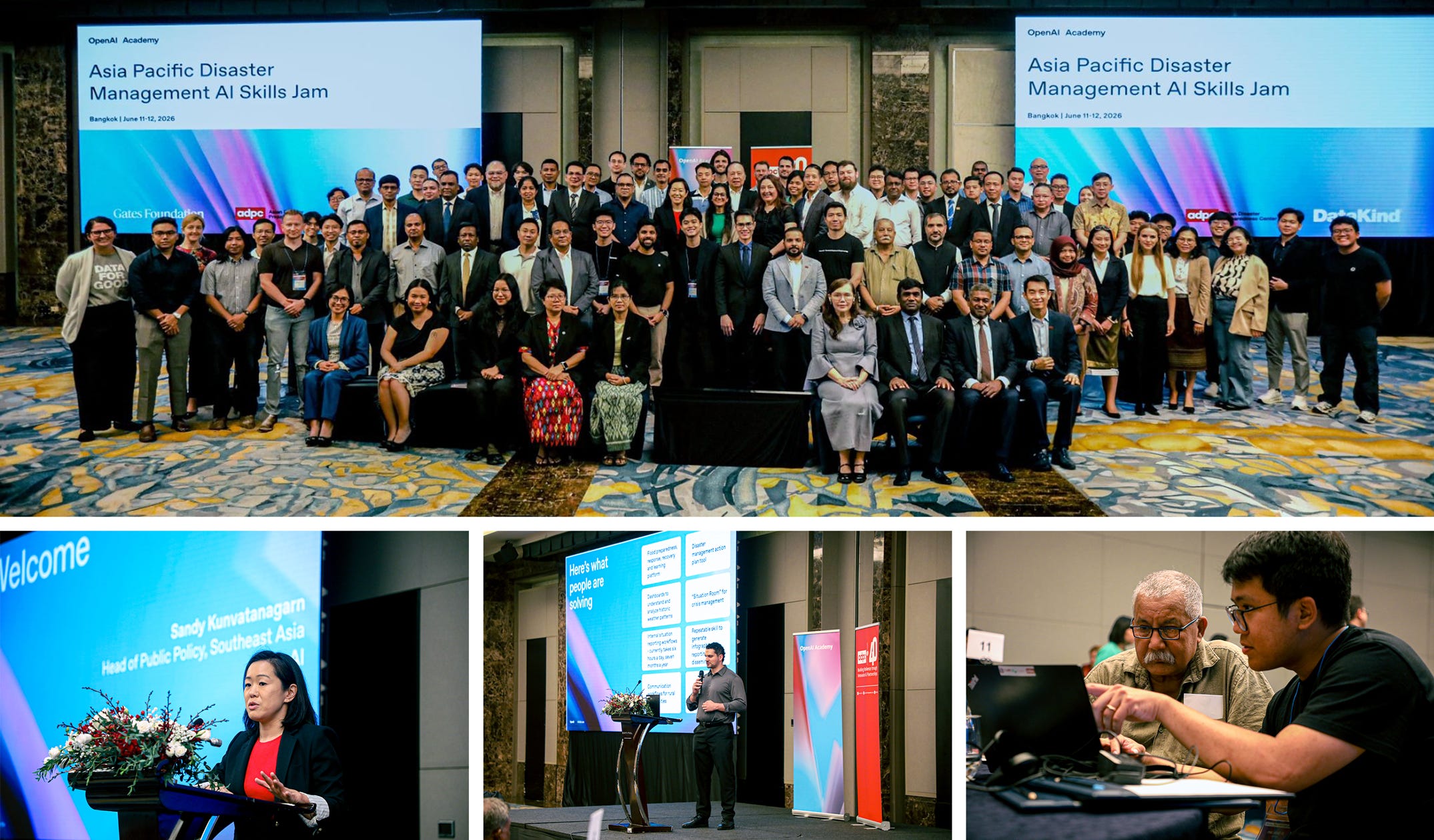
That’s where AI can help. At OpenAI’s recent Builder Lab in Bangkok, disaster-management professionals from 13 countries across South and Southeast Asia worked alongside local builders, DataKind volunteers, and OpenAI staff to create AI-powered workflows for real-world emergencies.
The event built on an AI literacy program we held earlier in the year. In the months that followed, conversations with participating agencies revealed a common pain point: information overload. Critical updates arrive through spreadsheets, PDFs, WhatsApp messages, field reports, and handwritten notes. One participant estimated spending six hours every day for months compiling situation reports by hand.
So instead of simply teaching AI, teams spent the week building. Participants developed tools to automate some of the most time-consuming parts of disaster response:
a flash-flood risk map for Thailand’s Department of Water Resources
a flood early-warning dashboard for Myanmar
and a prototype from Pakistan’s EHSAR that maps household-level needs from SMS, voice calls, and field reports.
The gathering also reinforced an important lesson about building trustworthy AI. For humanitarian teams, accuracy matters as much as speed. Participants learned to define workflows, identify where human review belongs, validate critical data, and test outputs against real operational needs.
It was a glimpse of how AI can help disaster responders spend less time wrestling with broken information systems – and more time helping the communities that depend on them. – Alex Nawar, OpenAI Academy

[About] OpenAI Forum
Explore Forum programming by and for our community of approximately 75,000 AI experts and enthusiasts from across tech, science, medicine, education, government, and other fields.

2:15 PM – 3:00 PM EDT on Jul 9
[Disclosure]
Graphics created by Base Three using ChatGPT.