


Hi
Welcome (back) to The Prompt. What’s in this edition:
More than 70 million ChatGPT requests each week focus on faith, religious texts, and spiritual questions
Chris Lehane: AI should expand human judgment and freedom, not displace them
Public opinion of AI remains under water in our latest AI Sentiment Tracker
If this was forwarded to you and you find it helpful, make sure you’re signed up for the next issue.

[Insight] 70 million prompts about faith
Every week, people around the world turn to ChatGPT more than 70 million times with questions primarily about religion, from studying sacred texts to understanding religious traditions to preparing for worship.
That’s one finding from OpenAI’s new report, Faith, Community & AI, which examines how people are using ChatGPT to support their religious lives.
The numbers tell part of the story:
22 million requests per week involve studying religious texts, including understanding difficult passages and exploring scholarly interpretations.
16 million requests per week concern religious practices, holidays, and observance.
Another 16 million requests per week focus on beliefs, meaning, and spiritual guidance.
These conversations span religious traditions and often reflect the rhythms of religious life. Questions about Islam rise around Ramadan, Christianity-related requests increase around Easter, and questions about Jewish observance grow around Passover.
Behind the data are personal stories.
In Washington, D.C., pastor Ben Palka uses ChatGPT to explore how younger congregants might interpret biblical passages, helping him develop ideas for sermons without having AI write them.
In Texas, Rabbi Andrew Bloom uses a customized ChatGPT study guide to navigate centuries of Jewish commentary, spending less time searching for sources and more time thinking about them.
And in California, Sandhya Simhan, a Hindu educator, has used ChatGPT to explore how her religious beliefs – including her understanding of personal duty – apply to important decisions in her life.
The common thread is that people are using AI to deepen their understanding of their faith, not to replace it.
AI can help people engage with religious traditions and communities, while leaving questions of faith, spiritual guidance, and religious authority where they belong: with people and their communities.

[Perspective] AI is a tool – to help people
As AI becomes more capable, more questions are arising over whether machines can possess human qualities, or even something resembling a soul.
In a new essay, OpenAI Chief Global Affairs Officer Chris Lehane argues that these questions deserve respectful consideration, but shouldn’t distract from a more fundamental principle: AI is a machine built by people, and our responsibility is to make sure it works for them.
Drawing on observations from Pope Leo XIV and Sam Altman, Lehane argues that AI’s greatest promise isn’t replacing human creativity or judgment, but expanding what people can accomplish.
He outlines three principles for realizing that promise: alignment with human intentions, openness about AI’s capabilities and limitations, and human agency over how the technology is used.
And Lehane makes a broader argument about governance: Decisions about AI’s future should be shaped by public debate and democratic institutions, not technology companies alone.
The ultimate goal with AI is to give people more freedom, creativity, and power to shape their own futures.

[Data] AI sentiment remains under water
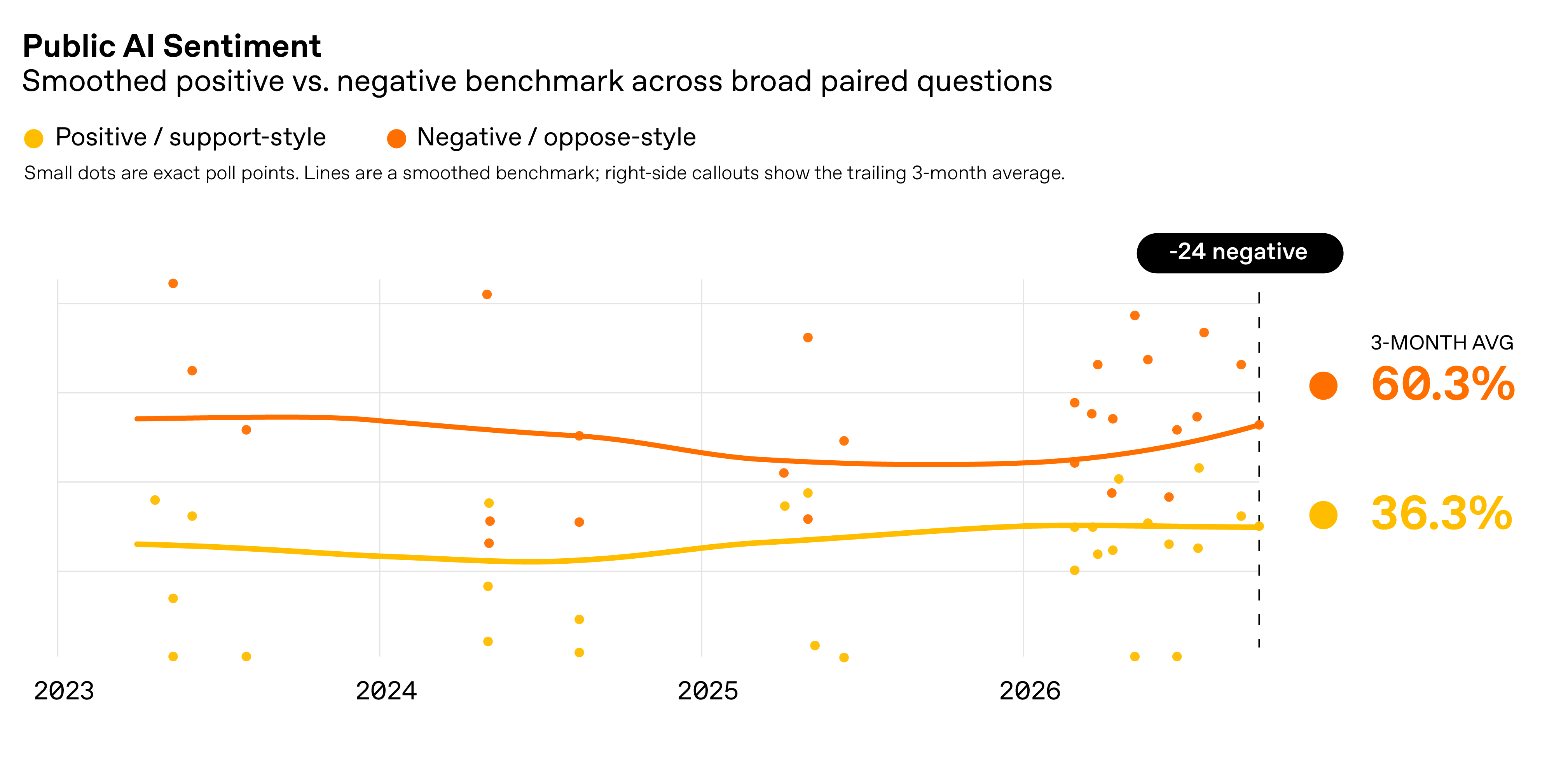
Americans remain more skeptical than enthusiastic about AI, according to the latest findings from our AI Sentiment Tracker.
Our latest three-month rolling average stands at negative-24, with negative views of AI outweighing positive ones by 60.3% to 36.3%.
The findings reinforce a persistent trend: Despite rapid advances in AI capabilities and adoption, public sentiment remains decidedly negative.
Our Tracker, built and automated with Codex, combines publicly available polling on AI’s benefits and risks, favorability, and optimism versus pessimism to provide a directional benchmark of public sentiment over time.

[About] OpenAI Forum
Explore Forum programming by and for our community of more than 85,000 AI experts and enthusiasts from across tech, science, medicine, education, government, and other fields.

4:30 PM – 9:00 PM EDT on Oct 13
[Disclosure]
Graphics created by Base Three using ChatGPT.
What is really exciting is AI putting the final nail in the coffin of Abrahamic religions